Swansboro, North Carolina History
. . . A Small Colonial Village By The Sea
Pages
This small quaint seaport has roots back to April 7, 1730 when Isaac and Jonathan Green Sr. purchased from Ebenezer Harker "a certain plantation and track of land containing by estimation 441 acres situate lying and being in ye Carterett in ye county of province of aforsaid being ye west side of ye mouth off White Oak River." By 1771 Theophilus Weeks started a town on his plantation, laying out a plat and selling lots. Formerly known as Bogue, Week's Point, The Wharf and New Town, the town was officially designated by the North Carolina General Assembly on May 6, 1783. Above photo courtesy Jack Dudley . Swansboro - A Pictorial Tribute . North Carolina State Archives. The above links open SPECIAL PAGES; please SEE SIDEBAR to navigate to specific posts.
1790 Census Records
Included in this link (posted on the Beaufort NC history site) are 1790 census images from the 1908 NC volume - Heads of Families NC 1790 - Also transcribed is some interesting history from the introduction, which gives one a better sense of what it was like in 1790 when George Washington ordered the first census. At that time, Carteret County included a much larger area, north to what is now part of Craven and Hyde Counties and south to what is now part of Onslow County; counties gained from, and lost to, other counties as lines were finally set. Even though it covered a large area, Carteret had a total of only 3,732 inhabitants, the least of any county in the New Bern District. By browsing through the images, viewers will note names like Theophilus Weeks. CLICK BOOK IMAGE or LINK ABOVE.
John Andrew Pittman House circa 1880-90
Born in Pitt County, North Carolina, Swansboro merchant John Andrew Pittman (1839-1917) was the son of John Pittman and Mary Gregory.
On December 28, 1861, John Andrew Pittman enlisted in Company B, North Carolina 3rd Cavalry Regiment.
In 1868 John A. Pittman married Olive Elizabeth “Betty” Ward (1846-1928) in Jacksonville, Onslow County, NC. “Betty” was the daughter of George Washington Ward and Olive Sanders. In 1870, John was a farmer in White Oak Township, Onslow County, post office Palo Alto, with wife “Betty” and one-year-old daughter Ida. Eight men were listed under his household as “farm laborers.”
By 1880, John A. Pittman was at home in Swansboro with his wife and five children. Their children were Ida V. (1869-1951) married Robert L. Williams; Augustus Ward (1871-1951) married Susan Green Duffy; Clyde S. (1874-1931) married Clara Bloodgood; Susan (1876-1959) married Percy Bell; Kate (1879-1958) married Wm. Francis Midyette; Laura Venters “Daisy” (1882-1972) married Bryan Hatsell; and Fredrick Blount (1884-1955) married Julia Bloodgood.
In 1896, James T. Bartley sold his store on Front Street to John Pittman; the store became known as “The Pittman Store.” That same year, Pittman was the mayor of Swansboro—population 300.
On February 9, 1917, Mr. Pittman died from a heart condition at the age of 77. The 1920 census noted his son Fred, a butcher, wife Julia and eight-year-old son Fred Wilson Pittman in the house with John A. Pittman’s sixty-year-old widow, who died eight years later.
Fred B., Julia and their twenty-seven-year-old son Fred W. Pittman were living in the house in 1940. On December 5, 1955, seventy-one-year-old Fred Pittman, who suffered from mental depression, committed suicide in the home; “hemorrhage from neck wound.” Julia Bloodgood Pittman died a few months later.
The house was moved to highway 58 in the early 1970s.
The painting, by Mary Warshaw, was inspired by an image in Swansboro – A Pictorial Tribute by Jack Dudley.
On December 28, 1861, John Andrew Pittman enlisted in Company B, North Carolina 3rd Cavalry Regiment.
In 1868 John A. Pittman married Olive Elizabeth “Betty” Ward (1846-1928) in Jacksonville, Onslow County, NC. “Betty” was the daughter of George Washington Ward and Olive Sanders. In 1870, John was a farmer in White Oak Township, Onslow County, post office Palo Alto, with wife “Betty” and one-year-old daughter Ida. Eight men were listed under his household as “farm laborers.”
By 1880, John A. Pittman was at home in Swansboro with his wife and five children. Their children were Ida V. (1869-1951) married Robert L. Williams; Augustus Ward (1871-1951) married Susan Green Duffy; Clyde S. (1874-1931) married Clara Bloodgood; Susan (1876-1959) married Percy Bell; Kate (1879-1958) married Wm. Francis Midyette; Laura Venters “Daisy” (1882-1972) married Bryan Hatsell; and Fredrick Blount (1884-1955) married Julia Bloodgood.
In 1896, James T. Bartley sold his store on Front Street to John Pittman; the store became known as “The Pittman Store.” That same year, Pittman was the mayor of Swansboro—population 300.
On February 9, 1917, Mr. Pittman died from a heart condition at the age of 77. The 1920 census noted his son Fred, a butcher, wife Julia and eight-year-old son Fred Wilson Pittman in the house with John A. Pittman’s sixty-year-old widow, who died eight years later.
Fred B., Julia and their twenty-seven-year-old son Fred W. Pittman were living in the house in 1940. On December 5, 1955, seventy-one-year-old Fred Pittman, who suffered from mental depression, committed suicide in the home; “hemorrhage from neck wound.” Julia Bloodgood Pittman died a few months later.
The house was moved to highway 58 in the early 1970s.
The painting, by Mary Warshaw, was inspired by an image in Swansboro – A Pictorial Tribute by Jack Dudley.
Mary Elizabeth Gibson 1837-1918
Mary Elizabeth Gibson, daughter of William J. Gibson 1805-1860 and Susannah Simmons 1814-1890, of Onslow County, married Edward Ward “Ned” Mattocks June 9, 1857 in Onslow County; the marriage was performed by David W. Sanders, justice of the peace.
On January 23, 1862, 28-year-old Edward Ward Mattocks enlisted as a private in Swansboro with Company B, 3rd NC Calvary Regiment--later 41st NC State Troops. This unit was initially known as Edward W. Ward's Company or "Gatlin's Dragoons." Mattocks enlisted for twelve month, but on February 28, 1862, for a $50 bounty, he extended his service to two years. Mattocks was promoted to 4th Sergeant on June 8, 1862.
In the 1870 census, Edward Ward Mattocks was head of household with wife Mary and son William Edward Mattocks. Also in the house were servants Charity Dixon and Alexandra Mundine. Edward was noted as a retail grocer. By 1910, 77-year-old Edward was recorded with wife Mary in the Mattocks House on Front Street.
On January 23, 1862, 28-year-old Edward Ward Mattocks enlisted as a private in Swansboro with Company B, 3rd NC Calvary Regiment--later 41st NC State Troops. This unit was initially known as Edward W. Ward's Company or "Gatlin's Dragoons." Mattocks enlisted for twelve month, but on February 28, 1862, for a $50 bounty, he extended his service to two years. Mattocks was promoted to 4th Sergeant on June 8, 1862.
In the 1870 census, Edward Ward Mattocks was head of household with wife Mary and son William Edward Mattocks. Also in the house were servants Charity Dixon and Alexandra Mundine. Edward was noted as a retail grocer. By 1910, 77-year-old Edward was recorded with wife Mary in the Mattocks House on Front Street.
Bartley House Privy


According to the Swansboro Historical Association brochure, "Older residents suggest that the building once served as a post office and was located on Front Street. An architectual historian remarked on its similarity to milkhouses. Note the guilded-age 'vents.' Privy, post office or milkhouse, this building is a Swansboro conversation piece."
James Thomas Bartley, born in South Carolina on April 27, 1864 to Edward Bartley and Annie Keman, came to Swansboro by way of Wilmington about 1893. He built this home for his bride - Georgia A. Smith, born to George W. and Missouri Smith, of Silverdale, NC, on August 23, 1870.
Georgia Bartley was postmistress from 1907 to 1914--perhaps this is the connection to the "privy post office." Bartley was a prominent local businessman - a retail merchant on Front Street. His first store (left) was just east of the Old Brick Store. His early "party boat" was named Little Georgia. Bartley was a former mayor of Swansboro but an unsuccessful candidate for Congress. More on the Bartley House...
UPDATED HISTORY of the PETER RINGWARE HOUSE
![]() |
| Painting by Beaufort artist Mary Warshaw |
NATIONAL REGISTER OF HISTORIC PLACES (Daniel Pezzoni 1989): Peter Ringware House circa 1778 - 209 Main Street. Possibly the oldest house in Onslow County, the Ringware House is a Georgian/Federal style five-bay house with engaged two-tier front and back porches, a large first floor room on one side of a center hall and a pair of rooms sharing a chimney on the other side. Most original interior and exterior hardware and woodwork survive. Early 19th century one-story rear kitchen and dining room, formerly semi-detached. Ringware was a captain. His house was owned by many prominent Swansboro citizens throughout the 19th century. Archaeological explorations undertaken in the 1960s suggested a late 18th century date of construction. (NR) Click Here for the complete update.
B. Cameron Langston Bridge 1971
![]() |
| Image courtesy www.freebase.com |
Bryant Cameron Langston Sr. was born April 8, 1909 in Lenoir County, North Carolina; he died in Kinston, Lenoir County on October 25, 1966. He married Lena Rivers Fields (1911-2001) on June 12, 1929. Langston was the son of John Clayton Langston and Minnie Brown, also of Lenoir County.
![]() |
| Photo courtesy David Sobotta |
Hawkins-Glover Family Cemetery
![]() |
| John Rolph 1745-1771 |
![]() |
| John Rolph 1745-1771 |
Buried in the small Hawkins-Glover family cemetery were:
John J. Farr 1818-1839
Catherine Jane Glover 1833-1868
Cyrus B. Glover 1821-1867
John D. Hawkins 1830-1921
William H. Hawkins 1845-1926
and John Rolph 1745-1771.
Two of the grave markers that remain visible on Elm Street, those of John Rolph (perhaps a descendant of Rolph and Pocahontas) and John J. Farr.
John J. Farr was perhaps the son of Titus Farr and Levisey Ambrose, who married in Onslow County in 1796. Levisey, born about 1775, was the daughter of 1747 Daniel Ambrose. Titus Farr was listed on the 1810 Onslow County census.
![]() |
| John Rolph 1745-1771 |
![]() |
| John Rolph 1745-1771 |
![]() |
| John J. Farr 1818-1839 |
![]() |
| John J. Farr 1818-1839 |
In
1975 town workers discovered the grave of Cyrus B. Glover during road
repair. The exhumed iron coffin is currently stored in the Onslow County
Museum.
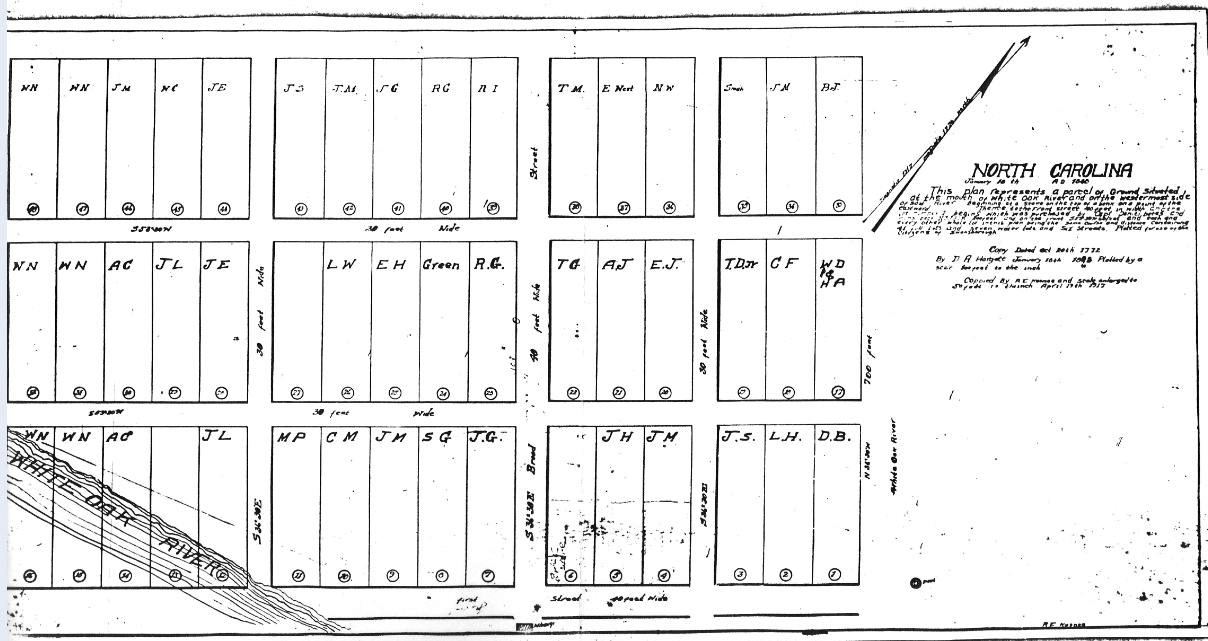
Copy of the Original 48-Lot Town Grid
NATIONAL REGISTER OF HISTORIC PLACES
![]() |
| Aerial View 1940s . Image Courtesy North Carolina State Archives This page is a transcription from the application to nominate Swansboro to the NATIONAL REGISTER OF HISTORIC PLACES Prepared and written in 1989 by architectural historian Daniel Pezzoni |
STATEMENT OF SIGNIFICANCE
Swansboro, a tiny port established in 1770 on Bogue Sound at the mouth of the White Oak River in Onslow County, is a remarkably unaltered waterfront village of approximately 150 densely-clustered houses and commercial buildings. The historic district includes the town’s surviving antebellum building stock of five houses and two store buildings as well as several virtually intact blocks of frame houses dating to the period of the town’s lumber boom, between the years 1880 and 1925. These lumber boom houses display a distinctive local variation of typical late Victorian exterior and interior milled ornament.
Swansboro’s major commercial and industrial role as Onslow County’s foremost port from the eighteenth through the early twentieth centuries is documented in the Onslow County Multiple Property Documentation Form: Naval Stores and Lumber Production in Onslow County, 1754-1938. The town served as a center for fishing, boatbuilding, and naval stores processing and shipment before the Civil War. After the war, the town hosted a succession of large lumber mills. Unlike the coastal towns of Beaufort and Morehead City in adjacent Carteret County, which grew large owing to fine harborage and rail connections, Swansboro remained isolated and tied to its immediate hinterland. Consequently, Swansboro represents one of the smallest and most traditional maritime communities surviving on the North Carolina coast. MUCH MORE. . .
WILLIAM GIBSON HOUSE circa 1775
![]() |
| GIBSON HOUSE (Holland Family renters*) - 1920 Left to right: Alonza 1871-1952, Lina (Canady)1885-1947 holding Iva, Clarence, Beatrice, Marie, Lila Mae and Haywood. |
![]() |
| GIBSON HOUSE - Photo circa 1940s |
A 1920 photo from Mel Guss shows Holland family renters on the front porch. *(photo above) Left to right: Alonza 1871-1952, Lina (Canady)1885-1947 holding Iva, Clarence, Beatrice , Marie, Lila Mae and Haywood. Alonza Deene (Riggs) Holland was born in Swansboro, son of Everette Riggs and Caroline Watson.
The old Gibson family land near Maysville was first acquired by a 1751 land grant to William Gibson 1720-1788, husband of Mary Barclift. On this land, near the Jones County line, where the White Oak River Road meets Gibson Branch Road and Gibson Bridge Road, Gibson built what was called the "White Oak Plantation." He was a carpenter and built the first Onslow County courthouse.
At some point the Gibson family had to sell their property. However, the land was brought back into Gibson hands when William J. Gibson purchased it between 1835-1837.
The "White Oak Plantation" home no longer exists. The Gibson cemetery, on private property off Gibson Branch Road, has only one readable headstone--that of Susannah, wife of William J. Gibson.
![]() |
| Julia Ann Gibson Harget Stephens |
![]() |
| Susannah Simmons Gibson |
William J. Gibson married Susannah Simmons 1814-1890 on May 29, 1832. Susannah Simmons was born in Onslow County to Obedira Isler Simmons and Julia McDaniel. Both families had been in Onslow County for many generations.
The 1860 Swansboro Census recorded William J. Gibson 55, wife Susan 46 and 9-year-old Benjamin. The value of his real estate was noted as $5200 with a personal estate of $25,000. At that time, Gibson was the owner of many slaves occupying six slave houses.
![]() |
| Ben Gibson and Cousin Dollie |
![]() |
| Hester & daughter Minnie Ward |
![]() | |
| Noma Mattocks Harget |
![]() |
| Edgar Harget |
![]() |
| Susan Caroline Gibson |
![]() |
| Julia Mattocks Hardison |
The Reverend John Mattocks was in charge of the Swansboro Male and Female Academy which opened in 1857 but closed at the time of his death in 1868. Another academy used the building until the early 1900s, when it was replace by the Methodist Parsonage.
![]() |
| "Julia with Lila" |
*Tintype, also melainotype and ferrotype, were photographs made by creating a direct positive on a sheet of iron metal that had been blackened by painting, lacquering or enameling and was used as a support for a collodion photographic emulsion. Photographers usually worked outside at fairs and carnivals. Since the support of the tintype was resilient and did not need drying, photographs were produced in only a few minutes.
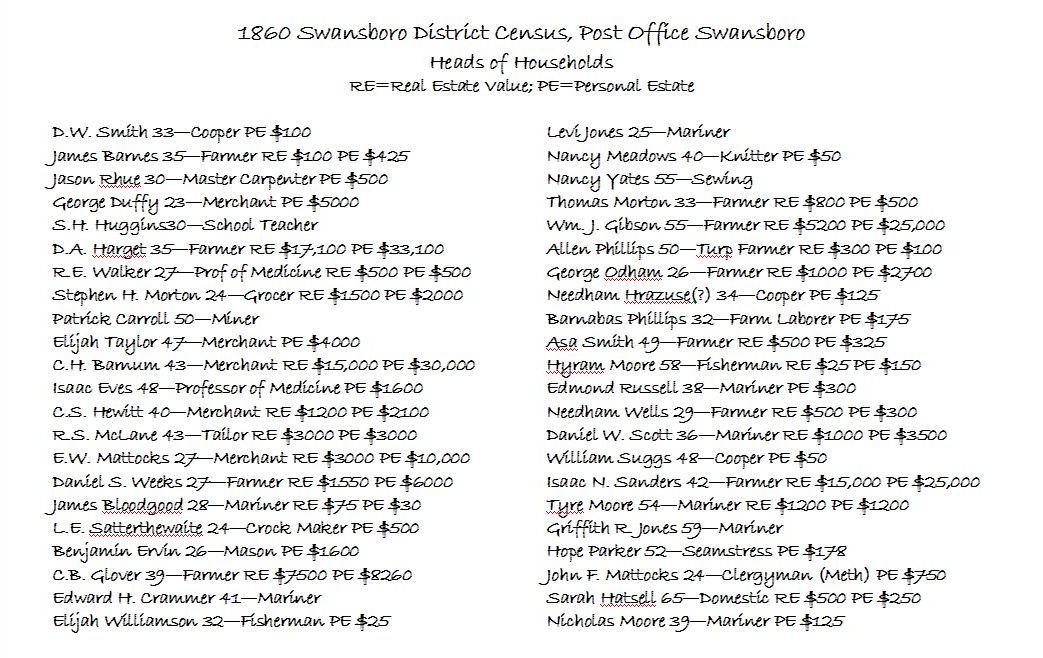
1860 Swansboro Census
1860 Swansboro District Census
111 Heads of Households
RE=Real Estate Value; PE=Personal Estate
Click to Enlarge
SWANSBORO METHODIST CHURCH circa 1880s
![]() |
| Late 1960s Photo . Courtesy Ora Smith |
In the 1880s the trustees of the Swansboro Male and Female Academy sold part of the academy lot (# 28) to the Methodist Church - corner of Church and Elm Streets The building remained on the site until it was razed in the 1960s.
According to Jack Dudley, Swansboro, A Pictorial Tribute, "In 1918 a hurricane blew the steeple off and it was replaced with a smaller one.The second story was used as a lookout tower during World War II. In 1931 the congregation moved to the Unitarian brick school, and the building was used as a motion picture theater. Later it was used as a warehouse."
MALE AND FEMALE ACADEMY
Ratified 2, February 1857
An Act to Incorporate the Male and Female Academy of the town of Swansboro and County of Onslow:
Sec. 1. Be it enacted by the General Assembly of the State of North Carolina, and it is hereby enacted by the authority of the same, That Phillip Koonce, C.B. Glover, J.N. Sanders, R.S. McLean, E.W. Sanders, D.W. Sanders, T.B. Holland, D.A. Humphrey, D.A. Harget, C.H. Barnum, R. Canady, be and they are hereby declared to be a body politic and corporate, to be known and designated by the name of "Trustees of the Male and Female Academy of the town of Swansboro," and by that name shall have succession and a common seal, and shall be invested with power and authority to sue and be sured, plead and be impleaded in any court of law in this State, and to hold such lands and tenements, goods and chattels, and moneys sufficient for all the purposes of the academy. [Public Laws of the State of North-Carolina, passed by the General Assembly at its Session of 1856-'57. Raleigh: Holden & Wilson, Printers to the State 1857.]
The Reverend John Frederick Mattocks was in charge of the Swansboro Male and Female Academy which opened in 1857 but closed at the time of his death in 1868. Another academy used the building until the early 1900s, when it was replace by the Methodist Parsonage.
HISTORY OF SWANSBORO UNITED METHODIST CHURCH
As early as 1760 the movement of Methodism had reached America, brought from England by the pioneer preacher, Joseph Pilmore, who had been converted by John Wesley. Pilmore began organizing classes in the southern states, following the pattern of John and Charles Wesley. This movement reached North Carolina in 1772. On May 21, 1776, the first North Carolina Circuit was established.
Francis Asbury, the first bishop of the Methodist Episcopal Church in the United States, visited Swansboro at least three times. This is an excerpt from his journal: “Wednesday, April 6, 1785-Preached at Swansbury in sight of the sea. Here are a wicked people indeed; nevertheless a few have joined society. Saturday and Sunday, December 24 and 25 (Christmas), 1785 we held quarterly meeting at Swansbury, many people—little religion. Thursday, January 27, 1791—I had many to hear at Swansbury—the people were attentive—O that God may bless His word to them.”
Little is known about the church during the period until 1871. There was a church which was attended by all denominations in the vicinity of the present Waterway Realty. There was a Northern Methodist Church in the same area which was sold to the Unitarians in 1907. This group came from the North and organized the Emmerton School.
The present church was organized on March 1, 1871. There were about 15 families in the village and a few from the adjacent area who were members. This group worshiped in the Old Brick Store and in a school building located about where First Citizens Bank building is currently. The preachers served all the surrounding churches, living for a time in Belgrade and later in Maysville. About 1880 the Methodists built a church on the corner of Church and Elm streets where everyone worshiped until the Baptists built their church.
The Swansboro Circuit was organized in 1908 and consisted of five and sometimes six churches. The parsonage was the house on the lot adjoining the church. About 1930 the congregation sold the church and the parsonage and purchased from the Unitarians the Emmerton School property. This was a U-shaped building and would house the sanctuary, the Sunday school area and the living quarters for the parsonage family. This building is now Swansboro Town Hall.
Francis Asbury, the first bishop of the Methodist Episcopal Church in the United States, visited Swansboro at least three times. This is an excerpt from his journal: “Wednesday, April 6, 1785-Preached at Swansbury in sight of the sea. Here are a wicked people indeed; nevertheless a few have joined society. Saturday and Sunday, December 24 and 25 (Christmas), 1785 we held quarterly meeting at Swansbury, many people—little religion. Thursday, January 27, 1791—I had many to hear at Swansbury—the people were attentive—O that God may bless His word to them.”
Little is known about the church during the period until 1871. There was a church which was attended by all denominations in the vicinity of the present Waterway Realty. There was a Northern Methodist Church in the same area which was sold to the Unitarians in 1907. This group came from the North and organized the Emmerton School.
The present church was organized on March 1, 1871. There were about 15 families in the village and a few from the adjacent area who were members. This group worshiped in the Old Brick Store and in a school building located about where First Citizens Bank building is currently. The preachers served all the surrounding churches, living for a time in Belgrade and later in Maysville. About 1880 the Methodists built a church on the corner of Church and Elm streets where everyone worshiped until the Baptists built their church.
The Swansboro Circuit was organized in 1908 and consisted of five and sometimes six churches. The parsonage was the house on the lot adjoining the church. About 1930 the congregation sold the church and the parsonage and purchased from the Unitarians the Emmerton School property. This was a U-shaped building and would house the sanctuary, the Sunday school area and the living quarters for the parsonage family. This building is now Swansboro Town Hall.
Revolutionary War Times
An 1876 print representing the "Declaration Committee," chaired by Thomas Jefferson, which was charged in June 1776 with drafting a declaration of independence for action by the Continental Congress. The "Declaration Committee," which included Thomas Jefferson of Virginia, Roger Sherman of Connecticut, Benjamin Franklin of Pennsylvania, Robert R. Livingston of New York, and John Adams of Massachusetts, was appointed by Congress on June 11, 1776, to draft a declaration in anticipation of an expected vote in favor of American independence, which occurred on July 2. Currier and Ives prepared this imagined scene of the writing of the Declaration for the 100th anniversary of the Declaration of Independence. Library of Congress
_____________________________
In Swansboro
In Swansboro
- Shortly before the Revolution—January 1, 1772—Theophilus and Grace Weeks signed a deed to Archibald Gillespie for half an acre of land. That was the last deed Theophilus ever signed. When the Onslow Court met just a few days later, one of the actions taken by the court was to appoint Archibald Gillespie inspector for Bogue Inlet "in the room of Theophilus Weeks, deceased."
- During the American Revolution, a warehouse was established at the mouth of the White Oak River to supply the Continental armed forces. Here, beef and pork were salted and barreled. A British blockade of the coast greatly reduced the importation of salt, making its production of critical importance. In response to the crisis, several salt works were established in the Swansboro area to produce salt from sea water. Jeremiah Hote operated a salt works on Deer Island during these years. Throughout the war, vessels from the port of Swansboro engaged in privateering, including that of Captain Peter Ringware. A military company from the town (then called “Bogue”) patrolled the coastal area.
- In Lucy Greene’ history, she wrote, “After the outbreak of the Revolution, White Oak River men did their part in the armies of the Revolution. There were no active Tories on the river and an effort was made to keep the exports and imports moving from the wharves at Swansboro. Beef and pork were salted near the mouth of the river for the American armies.
- Deed Book K, February 1776, “Thomas Hewitt and John Hewitt witness deed from Benjamin Weeks & Silas Weeks to Sarah, Mary, Francis and Margret Wallice ... land on Whiteoak River, being part known as The Wharf, formerly occupied by Theophilus Weeks, containing 76-1/2 ac. in Arcibald Gillespie's line.”
- Ordinances of Convention, 1776. North Carolina. Provincial Congress. November 22, 1776 - December 23, 1776: Be it ordained and declared by the Representatives of the Freemen of the State of North Carolina in Congress assembled, and it is ordained by the authority of the same … that William Gray, James Howard, Henry Rhodes, Lewis Williams, Thomas Johnston, Seth Ward, Benajah Doty, John Spicer, John Starkey, John Brinson, Stephen Grant, Edward Starkey, Robert Nixon, Archibald Gillespie, Stephen Williams, Richard Jerrat, Jacob Charleraft, Shadwick Hall, Reuben Grant, Esquires for the County of Onslow shall be Justices for keeping the peace and the Governor is hereby impowered to issue commissions to proper persons in each County and the said District to qualify the said Justices, and that they shall have power to hold Sessions of the Peace in their respective Counties…
- A last will and testament from 1776 - that of Archibald Gillespie:
...I will and bequeath unto my wife Lydia Gillespie one third of all my
moveable estate during her natural life with the peaceable possession of the plantation whereon I now live, till my son James Gillespie comes to the full age of twenty years. Then said plantations and all lands together with two thirds of my moveable estate to be sold at Public vandue and to be equally divided betwixt my four children now living,viz: Catherine, David, James & Borthwick Gillespie and in case my wife Lydia Gillespie be pregnant with child, male or female at this time or at the time of my death, to have an equal proportion with any of my four above mentioned children, and be it understood that I will and bequeath the above proportions unto said children and their heirs and assigns forever. And it further my will that the above third of my moveable estate bequeathed to my wife Lydia Gillespie be equally divided amongst my above-mentioned children at her death. It is further my twill and desire that my two sons David & James Gillespie may be sent to some of the Northern Provinces in America and there bound to some trade at the discretion of my executors hereafter mentioned. And I hereby nominate and appoint my wife Lydia Gillespie my executrix and my brother Brattick Gillespie my Executor...
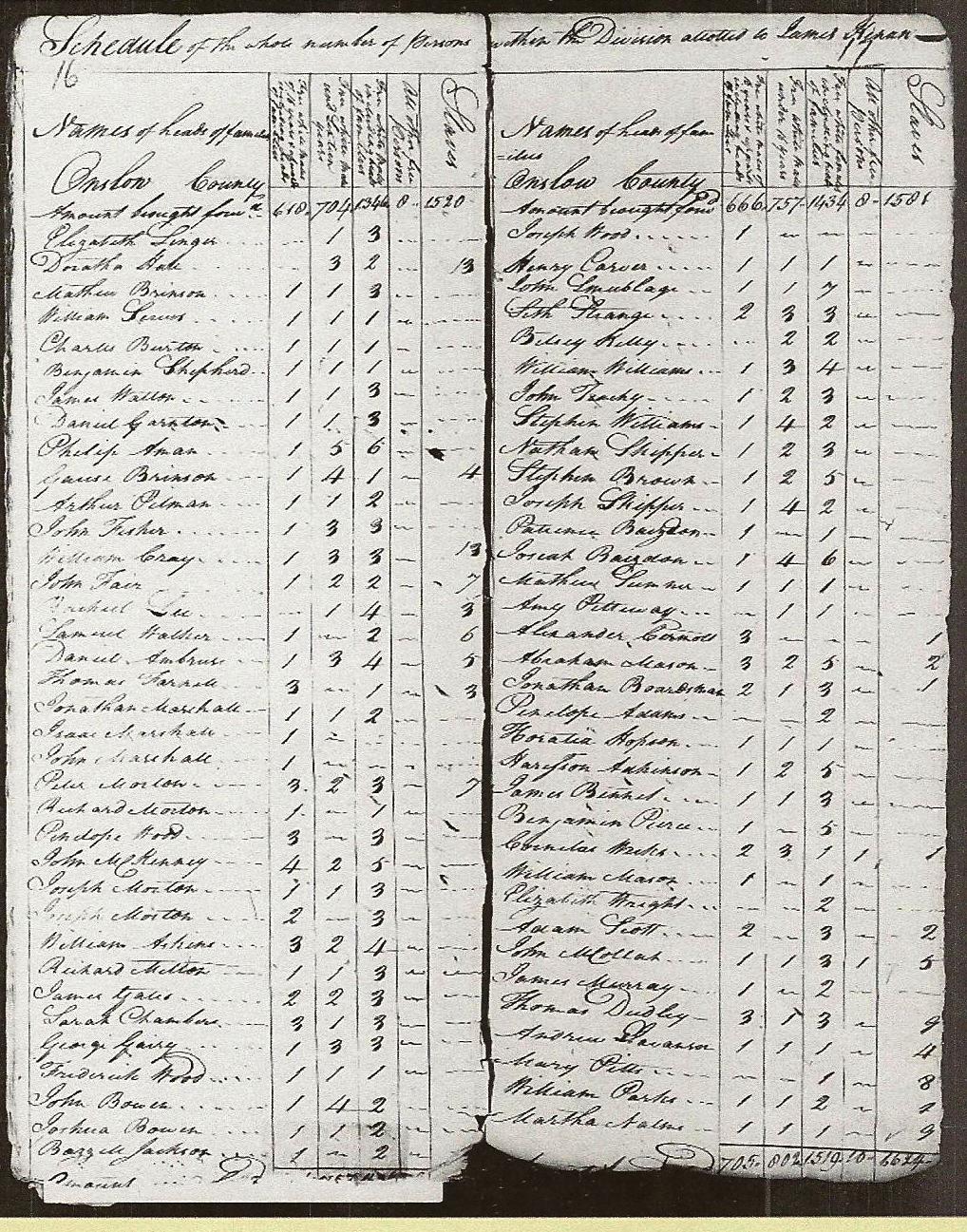
1790 ONSLOW COUNTY CENSUS
![]() |
| Double-click image for largest view. |
The 1790 Onslow County Census included Mary Pitts, of whom Tucker Littleton wrote, “That the establishment of a town on his property was the idea of Theophilus Weeks is further supported by the deed to Mrs. Mary Pitts for lot number 11. Mrs. Pitts received the deed for what was called ‘lot number 11 in the plan of a town laid out by Theophilus Weeks.’ It is, therefore, clear that the town that became Swansboro was the idea of Theophilus Weeks, who thereby earned the title of Founder of the Town of Swansboro.
The first enumeration began on Monday, August 2, 1790, little more than a year after the inauguration of President Washington and shortly before the second session of the first Congress ended. The Congress assigned responsibility for the 1790 census to the marshals of the U.S. judicial districts under an act that, with minor modifications and extensions, governed census-taking through1840. The law required that every household be visited and that completed census schedules be posted in ‘‘two of the most public places within [each jurisdiction], there to remain for the inspection of all concerned...’’ and that ‘‘the aggregate amount of each description of persons’’ for every district be transmitted to the President. The six inquiries in 1790 called for the name of the head of the family and the number of persons in each household of the following descriptions: Free White males of 16 years and upward (to assess the country’s industrial and military potential), free White males under 16 years, free White females, all other free persons (by sex and color), and slaves.
| Sanders Plantation .1863 . Valentine |
Isaac Newton Sanders 1777-1821
Last Will and Testament 6 Sept 1821
State of North Carolina
County of Onslow County
Will Book A
In the name of God, Amen: I, Isaac Sanders of the County of Onslow and State of North Carolina, Planter, being sick of body but of sound mind and memory thanks to God for the same knowing that death is inevitable to all men do think proper to dispose of the worldly goods with which it hath pleased God to bless me in the manner and form following after recommending my soul to God who gave it and my body to be buried at the descretion of my executors hereafter to be mentioned (VIZ):
ITEM: 1st, I loan to my beloved wife Ruth Sanders during her natural life the land I bought of John Sanders joining where I live with the house and salt works on the same and after my wife's death, my youngest son Isaac Newton Sanders to have the same land. I give to my wife Negro man Tom, Negro girl Iris, to dispose of as she may think proper, and Negro boy Antony until my son Isaac N. Sanders shall arrive at the age of twenty one years, then he is to have said Negro Antony also give to my wife my home republican and Jenney wagon four cows and calves two beds and furniture fifty barrels of corn and two thousand pounds of pork.
ITEM: 2nd, I give to my son David N. Sanders five Negroes (VIZ) Dick, Dash, Charles, Suck & Cate, also three hundred acres of land lying on the south west prong of New River one bed and furniture two cows and calves.
ITEM: 3rd, I give to my two sons Daniel S. Sanders and Benjamine W. Sanders equally all my lands east of the lands I bought of John Sanders including the house and salt works on the same also one hundred acres of land adjoining the wood place together with my Inland lands near Bear Inlet also my Negro fellow Charles my son Daniel S. Sanders is to have on the first day of next January all the property in his possession until Benjamin arrives at the age of twenty then my son Benjamin is to take the one half of all that I have bequeathed to him and son Daniel together with one half of the profits arising from said
lands salt works and Charles.
ITEM: 4th, I give to my three sons John A. Sanders, Edwrad W. Sanders & Isaac Newton Sanders the following negros (VIZ) Grasous, Bryan, Rose, Jane, Eli, Rachel and Elleck, black Mariah, Hester and Jack with their increase I bequeath unto my two sons John A. & Edward W. Sanders all my land not otherwise disposed of including my piny lands.
ITEM: 5th, I give to my daughter Nancy Sanders five Negroes (VIZ) Sarah, Marish, Jacob, Linkfield, and Mose, it is my will that my wife shall during her widowhood support and school my sons John A. Sanders, Edwrad W. Sanders, & Isaac N. Sanders and my daughter Nancy Sanders free and clear from all expenses to my estate and my wife shall in compensation for the same have all the profits arising from the lands and Negroes which I have given to my sons John A. Sanders, Edward W. Sanders and Isaac N. Sanders and daughter Nancy Sanders.
ITEM: 6th, All the stock and crop which is not therewise disposed of I wish it should be sold to pay my debts and also what debts is now due me is to be appropriated to the use of discharging my debts and after they are paid if anything is remaining, I wish it should be equally divided between all my children.
ITEM: 7th, I make and ordain my executors my worthy friend Daniel M. Dulany my son David N. Sanders and my son Daniel S. Sanders is to be qualified to this my last will at the age of eighteen this the sixth day of September eighteen hundred and twenty-one (six day of September 1821).
Isaac Sanders (Sr) (seal)
Signed and sealed in presence of
J. Ward
Benjamin Ward Sr
ONSLOW COUNTY: In court November term 1821, this will was proved in open court by the oath of Benjamin Ward & David W. Sanders one of the executors therein named qualified thereto.
Bannister Lester, clerk
by Robert C. Lester
In the name of God, Amen: I, Isaac Sanders of the County of Onslow and State of North Carolina, Planter, being sick of body but of sound mind and memory thanks to God for the same knowing that death is inevitable to all men do think proper to dispose of the worldly goods with which it hath pleased God to bless me in the manner and form following after recommending my soul to God who gave it and my body to be buried at the descretion of my executors hereafter to be mentioned (VIZ):
ITEM: 1st, I loan to my beloved wife Ruth Sanders during her natural life the land I bought of John Sanders joining where I live with the house and salt works on the same and after my wife's death, my youngest son Isaac Newton Sanders to have the same land. I give to my wife Negro man Tom, Negro girl Iris, to dispose of as she may think proper, and Negro boy Antony until my son Isaac N. Sanders shall arrive at the age of twenty one years, then he is to have said Negro Antony also give to my wife my home republican and Jenney wagon four cows and calves two beds and furniture fifty barrels of corn and two thousand pounds of pork.
ITEM: 2nd, I give to my son David N. Sanders five Negroes (VIZ) Dick, Dash, Charles, Suck & Cate, also three hundred acres of land lying on the south west prong of New River one bed and furniture two cows and calves.
ITEM: 3rd, I give to my two sons Daniel S. Sanders and Benjamine W. Sanders equally all my lands east of the lands I bought of John Sanders including the house and salt works on the same also one hundred acres of land adjoining the wood place together with my Inland lands near Bear Inlet also my Negro fellow Charles my son Daniel S. Sanders is to have on the first day of next January all the property in his possession until Benjamin arrives at the age of twenty then my son Benjamin is to take the one half of all that I have bequeathed to him and son Daniel together with one half of the profits arising from said
lands salt works and Charles.
ITEM: 4th, I give to my three sons John A. Sanders, Edwrad W. Sanders & Isaac Newton Sanders the following negros (VIZ) Grasous, Bryan, Rose, Jane, Eli, Rachel and Elleck, black Mariah, Hester and Jack with their increase I bequeath unto my two sons John A. & Edward W. Sanders all my land not otherwise disposed of including my piny lands.
ITEM: 5th, I give to my daughter Nancy Sanders five Negroes (VIZ) Sarah, Marish, Jacob, Linkfield, and Mose, it is my will that my wife shall during her widowhood support and school my sons John A. Sanders, Edwrad W. Sanders, & Isaac N. Sanders and my daughter Nancy Sanders free and clear from all expenses to my estate and my wife shall in compensation for the same have all the profits arising from the lands and Negroes which I have given to my sons John A. Sanders, Edward W. Sanders and Isaac N. Sanders and daughter Nancy Sanders.
ITEM: 6th, All the stock and crop which is not therewise disposed of I wish it should be sold to pay my debts and also what debts is now due me is to be appropriated to the use of discharging my debts and after they are paid if anything is remaining, I wish it should be equally divided between all my children.
ITEM: 7th, I make and ordain my executors my worthy friend Daniel M. Dulany my son David N. Sanders and my son Daniel S. Sanders is to be qualified to this my last will at the age of eighteen this the sixth day of September eighteen hundred and twenty-one (six day of September 1821).
Isaac Sanders (Sr) (seal)
Signed and sealed in presence of
J. Ward
Benjamin Ward Sr
ONSLOW COUNTY: In court November term 1821, this will was proved in open court by the oath of Benjamin Ward & David W. Sanders one of the executors therein named qualified thereto.
Bannister Lester, clerk
by Robert C. Lester
__________________________________
USGENWEB NOTICE: In keeping with our policy of providing
free information on the Internet, data may be used by
non-commercial entities, as long as this message
remains on all copied material. These electronic
pages may NOT be reproduced in any format for profit
or for presentation by other persons or organizations.
Persons or organizations desiring to use this material
for purposes other than stated above must obtain the
written consent of the file contributor.
The submitter has given permission to the USGenWeb Archives
to store the file permanently for free access.
This file was contributed for use in the North Carolina USGenWeb
Archives by: Beverly Cole | Sanders Plantation .1863 . Valentine |
David Ward Sanders 1800-1860
Last Will and Testament 1860
State of North Carolina
County of Onslow
Will Book 2
In the name of God, Amen: I, David W. Sanders, of the County of Onslow and State of North Carolina, being in perfect health of body and mind, but knowing it is appointed unto all men to die, do make and ordain this my last will and testament in the following manner.
State of North Carolina
County of Onslow
Will Book 2
In the name of God, Amen: I, David W. Sanders, of the County of Onslow and State of North Carolina, being in perfect health of body and mind, but knowing it is appointed unto all men to die, do make and ordain this my last will and testament in the following manner.
ITEM the first, I give to David, son of Docr. Philip Koonce one thousand dollars to be paid to his father Docr. P. Koonce, if alive, if not to his guardian.
ITEM the second, I give to Benjamin S. Gibson, son of Wm. J. Gibson, one negro girl by name of Sarah, the daughter of Fanny Scott, to him and his heirs forever.
ITEM 3rd, I give to David W. Sanders, son (of) Bro. Benjamin W. Sanders, five thousand dollars in money or good notes at the expiration of two years after my death, to him his heirs and assigns forever.
ITEM 4th, I direct my Executor to deliver of Bro. Isaac N. Sanders two notes I hold of his for fifteen hundred dollars each, with interest from 7th December 1854 or thereabouts, they being in part payment for the land sold him by me as Exr. of Edward W. Sanders, decd.
ITEM 5th, I give to David the son of Bro. Isaac N. Sanders, the lands whereon mymother last lived and died and the further sum of four hundred dollars for each year, beginning the 1st January 1862 and ending 1st January 1872, a term of ten years, to be expended in his education and support, to be under the direction of his father, if alive, if not then under the direction of my Exr., if or either of them if not alive, then by his guardian.
ITEM 6th, I give to my dearly beloved wife one half of all my slaves, her choice, in families, all my household & kitchen furniture, my carriage & horses, one years support for herself and family, absolutely together with the land I purchased of Edwd. S. Jones & W. T. Hill during her natural life. This property given her to be delivered at the expiration of two years after my death. Also, the further sum of two thousand dollars in money whenever she may wish it.
ITEM 7th, I give to my grandson Danl. L. Russell, son of my daughter (now dead) Caroline & her husband Danl. L. Russell, all the balance of my estate of every description, both real and personal but should he die with(out) leaving issue, then all his share of my property, I wish equally divided, between Bro. John A. Sanders, Isaac N. Sanders, David W. Sanders, son of Bro. Benjm W. Sanders & David, son of Bro. Isaac N. Sanders, to them their heirs and assigns forever.
ITEM 8th, I wish my Exr. to let Jno. A. Sanders, my esteem bro. have the use of ten thousand dollars free from interest, untill my grandson Danl. L. Russell arrives at the age of twenty one years, at that time to be accounted for, to my said grandson or to my Exr. if Daniel L. Russell, Jr., should die before that time.
ITEM 9th, I authorise Danl. S. Russell, one of my executors to sell my Jones County plantation if in his discretion he should deem it best for the interest of his son Danl. L. Russell.
ITEM 9th, (number repeated apparently in error) I give Bro. Newton my gold watch.
ITEM 10th, I wish my plantation & Negroes to be kept together under the direction and control of Danl. L. Russell, one of my Exr. for two years at least, after that he to act with them at his pleasure either to farm or rent out the lands & hire out the Negroes.
ITEM 11th, I appoint Danl. L. Russell, my Exr., as his son is the principal legatee, but should he die before his son Danl. arrives at age, then I appoint my beloved Bro. John A. Sanders, my Exr. to this my last will & testament, this the 17th day of July AD 1859.
(signed) D. W. Sanders
The word interlined in Item the 8th & second line "thousand" was interlined by me.
(signed) D. W. Sanders
State of North Carolina}
Onslow County}
Court of Pleas and Quarter Sessions December Term 1860
State of North Carolina}
Onslow County}
Court of Pleas and Quarter Sessions December Term 1860
A paper writing without subscribing witnesses, purporting to be the last will and testament of David W. Sanders, deceased, was exhibited for probate in open court by Daniel L. Russell, one of the executors therein named, and it is thereupon proved by the oath and examination of James L. Shivar and William E. Shivar that the said will was found among the valuable papers of the said David W. Sanders after his death and it is further proved by the oath and examination of three competent and credible witnesses, to wit James S. Shivar, Williams E. Shivar & Jasper Etheridge, that they are acquainted with the handwriting of the said David W. Sanders, having often seen him write, and verily believe that the name of the said David W. Sanders subscribed to the said will, and the said will itself and every part thereof, are in the handwriting of the said David W. Sanders, and it is further proved by the evidence of the three last mentioned witnesses, that the said handwriting is generally known to the acquaintances of the said David W. Sanders.It is therefore considered by the court that the said paper writing is the last will and testament of the said David W. Sanders and the same is ordered to be recorded and filed. Whereupon the executor appeared in open court and was qualified in due form of law.
Jasper Etheridge, CCC (clerk of county court)
___________________________________________
USGENWEB NOTICE: In keeping with our policy of providing
free information on the Internet, data may be used by
non-commercial entities, as long as this message
remains on all copied material. These electronic
pages may NOT be reproduced in any format for profit
or for presentation by other persons or organizations.
Persons or organizations desiring to use this material
for purposes other than stated above must obtain the
written consent of the file contributor.
The submitter has given permission to the USGenWeb Archives
to store the file permanently for free access.
This file was contributed for use in the North Carolina USGenWeb
Archives by: Beverly Cole CHARLES HICKOK BARNUM
![]() |
| AMBROSE-HARGETT CEMETERY - ONSLOW COUNTY |
Thomas Barnum, the fourth great grandfather of Charles Hickok Barnum, was the first Barnum to come to the new world.
Born in County Kent, England, Thomas Barnum (1625-1695) left England in 1640, settled in what would become Bethel, Connecticut and married Hannah Hurd of Norwalk, Connecticut. Several generations of the family were born in Connecticut including Charles Hickok Barnum. Thomas (1663-1730) married Sarah Beardsley. Ephraim Sr. (1710-1775) married Mehetabel Starr. Their grandson Philo (1779-1828), son of Ephraim Jr., was the father of Phineas Taylor “P.T.” Barnum (1810-1891) who founded what became Ringling Bros. and Barnum & Bailey Circus.
During the first half of the nineteenth century, Charles H. Barnum, William P. Ferrand, Cyrus Glover and Robert Spence McLean were the town’s chief exporters of naval stores; Barnum and Glover also operated a saltworks facility. In 1846 Charles H. Barnum became Swansboro’s second postmaster.
In the records of the US Southern Claims Commission, Disallowed and Barred Claims, 1871-1880 appears the case of C. H. Barnum, as follows:
Case of Estate of Charles H. Barnum. The County of Onslow, North Carolina. The above claimant owned two schooners which were sunk in the Inlets of North Carolina to obstruct the Channels. Barnum filed a claim in the Confederate Treasury Department for pay for the above vessels. House of Representatives US Feby/21/88. Received of Clerk, House of Reps. sundry papers in above named case. /ss/ J. Randolph, sec.
Charles and Alice Barnum had three known children. Mary Amelia Barnum, born in 1846, married Major Russell; their daughter Lina Russell (1870-1967) married Swansboro builder Robert Lee Smith.
Edward Hargett Barnum, the second child of Charles and Alice Barnum, was born in 1849. In 1887 Edward married Ida Dolly Harget Fulford, widow of Francis Joseph Fulford. In the 1900 census Edward and Ida Dolly were living in New Bern with stepson Joseph C. Fulford 19, stepdaughter Julia May Fulford 16, Charles Harget Barnum 10, and 8-year-old Robert Barnum.
In the 1850 Swansboro census, in the household were: Charles H. 33, merchant; Alice 28; Amelia 3; Edward H. 1; Z.B. Barnum 28, merchant and brother; Daniel A. Hargett 25, clerk; and E.H. Remick 32, teacher.
The third child of Edward and Ida Barnum, Charles Hickok Barnum Jr., was born in 1855.
In the 1860 Swansboro census, in the household were: C.H. 43, merchant; Alice 37, seamstress; Amelia 13; Edward 10; Charles 5; William H. Hawkins 16, domestic; Arabella Sanders 12. The value of Barnum’s real estate was noted as $15,000, with a personal estate of $30,000. At that time, Charles H. Barnum owned twelve slaves.
Both Edward and Ida Barnum were buried in the Ward-Jones Cemetery in Swansboro.
Charles Hickok Barnum and Alice Hargett Barnum were buried in the Ambrose-Hargett Cemetery on Hammock Beach Road in Onslow County. Others interred there include Daniel Ambrose (1781-1850), Daniel Ambrose Hargett (1825-1872) and Rosamond Ambrose Hargett (1795-1859).
| 1860 SWANSBORO CENSUS |
![]() |
| PHINEAS TAYLOR "P.T." BARNUM |
DAVID WARD SANDERS and Family
![]() |
| PALO ALTO PLANTATION |
![]() |
| PALO ALTO PLANTATION |
| Map Showing Site of Palo Alto Plantation - Sander's 1840-1860 Farm and Distillery |
![]() |
| Isaac Sanders 1777-1821 Sanders Family Cemetery |
Francis Sanders 1676-1744 born Isle of Wight, Virginia married Mary ____.
John Sanders 1690-1751 born in Onslow County married Mary Neal.
John Sanders 1725-1796 born in Chowan County married Rebecca Shepherd.
Isaac Newton Sanders 1777-1821 born in Onslow County married Ruth Ward.
David Ward Sanders 1800-1860 born in Onslow County married Alice Mitchell.
Children of Isaac Newton Sanders and Ruth Ward: David Ward Sanders 1800-1860, Daniel S. Sanders 1800-1854, Benjamin W. Sanders 1807-1880, John A. Sanders 1809-1880, Edward Ward Sanders 1811-1854, Nancy Sanders 1813-1846 and Isaac Newton Sanders 1817-1866. (Jones Family Tree on Ancestry.com)
In his 1821 Will, Isaac Sanders "loaned to his wife land he had purchased from John Sanders including house and salt works; after her death to Isaac. To son David, three hundred acres lying on the southwest prong of the New River. To Daniel and Benjamin lands bought from John Sanders including house, salt works and one hundred acres of land adjoining the wood place together with my Inland lands near Bear Inlet. To John A., Edward all my land not otherwise disposed of including my piney lands.”
His marker in the Sanders Family Cemetery in Hubert reads: "In Memory of ISSAC SANDERS who was born the 19th day of May 1777, and died the 8th day of Sep. 1821, & was the Father of 11 Children." This cemetery is on private property off Bear Creek Road.
![]() |
| DAVID WARD SANDERS Portrait circa 1852 Artist: William Carle Brown TN State Library and Archives |
August 20, 1800 – August 26, 1860
- NC Clerk of Superior Court
- Representative 1855
- Constitutional Convention
- Grandson Daniel L. Russell Jr. was NC governor 1897-1901
- David’s wife Alice Mitchell was the daughter of George Warren Mitchell 1770-1830 and Phoebe Ogden Starkey 1790-1857 of Onslow County.
Children of David W. and Alice Mitchell Sanders: Caroline Elizabeth Sanders 1825-1845 (mother of Governor Daniel Russell), Isaac B. Sanders 1829-1851, twin of George Edward Sanders 1829-1836, J.B. Sanders born 1829 and Benjamin Sanders born 1831.
1820 Census, Onslow County, North Carolina:: 4 Persons in Household
1830 Census: 31 Persons in Household including 23 Slaves
1840 Census: 87 Persons – 82 Slaves – 57 Engaged in Agriculture
Free White Persons - Males - 10 thru 14: 1
Free White Persons - Males - 30 thru 39: 1
Free White Persons - Males - 40 thru 49: 1
Free White Persons - Females - 30 thru 39: 1
Free White Persons - Females - 60 thru 69: 1
1850 Census, White Oak, Onslow County, North Carolina:
Farmer D.W. Sanders, 49, Alice 44, Phoebe O. Mitchell 70, J.B. Sanders 21 “sawyer,” Oden Taylor 20 overseer. Value of real estate owned was $28,000.
1850 Slave Schedule, White Oak Township: D.W. Sanders - 134 slaves including children of slaves. The 1860 Slave Schedule noted D.W. Sanders with 188 slaves and 32 slave houses.
1850 Manufacturing Schedule – Turpentine Distillery: $4000 Capital invested; Raw Materials – Quantity 30,000, Value $37,500; Steam Power; 6 hands employed; Wages $72 per month; Annual – Quantities 25,000, Rosin and Turpentine, Value $35,800.
1860 Census, White Oak, Onslow County, North Carolina – Post Office Palo Alto:
Farmer David W. 64, Alice 54 and M.W. Draughn 26 overseer.
| Part of D.W. Sanders 1859 Will |
In his 1859 will, David Ward Sanders left a great deal of money, for that time, to his wife and children along with “my plantation & Negroes to be kept together under the direction and control of Danl. L. Russell, one of my Exr. for two years at least, after that he to act with them at his pleasure either to farm or rent out the lands and hire out the Negroes.”
The following were buried in Hickory Hill (D.W. Sanders Cemetery) located adjacent to 3210 Belgrade-Swansboro Road, Maysville, Onslow County, NC:
- Alice Mitchell Sanders and David W. Sanders
- 1) Isaac B. Sanders son of David W. and Alice Sanders, age 22 yrs 5 mos 6 days 2) George E. 1836 twin brother of Isaac B. Sanders age 6yrs 11 mos 5 days 3) Carolina E. 1842 wife of Daniel L. Russell and daughter of David W. and Alice Sanders, age 20 yrs 3 mos 9 days
- 1) Daniel Lindsay Russell* 1845-1908 son of Daniel Lindsay Russell and Elizabeth Caroline Sanders—Statesman – Jurist – Soldier. Gov of NC 1897-1901. CAPT CO. G 2NC ARTILLERY CSA 2) Sarah Amanda Sanders Russell, 1844- 1913 daughter of I.N. and S.C. Burns Sanders, wife of D. L. Russell - Inspirer of educators, temperance advocate, woman suffrage pioneer
![]() |
| Caroline E. Sanders Russell 1825-1845 |
![]() |
| Governor of North Carolina 1897-1901 |
![]() |
| Daniel L. Russell 1845-1908 - Sanders-Hickory Hill Cemetery |
By the early 1890s agrarian unrest and economic depression split the Democratic Party. An alliance with Populists resulted in victories in 1896 that removed control of the legislature from the Democrats and placed Republican Russell in the governor's office. During Russell's administration, the Railroad Commission gave way to a Corporate Commission and a new law provided for popular election of the Commissioner of Agriculture. Some of the greatest gains came in education.
One of Russell's disappointments was his inability to recover the North Carolina Railroad from its lease to the Southern Railway. In the last two years of his term, the Democratic Party resurrected the racial issue and staged the "Red Shirt" campaign, capturing the legislature and many state offices. The Democrats virtually negated any gubernatorial powers, witness Russell's ineffectiveness in using state troops to quell the 1898 Wilmington race riot. Further insult followed when Russell was forced to accept the "grandfather clause" effectively prohibiting blacks from voting.
After leaving office, Russell returned to Brunswick County to try to recoup financial losses due to agricultural failures. At his death in May 1908, his estate cleared only $1,000. Russell is buried in a family plot at Belgrade in Onslow County. Source
![]() |
| PALO ALTO PLANTATION |
![]() |
| Side Porch - PALO ALTO |
- In 1874 (Bk. HH, p. 49), James and William Hatsel bought from D. W. Sanders land known as Hatchell’s Point lying at mouth of Hadnot’s creek. This land included the mill site and the Dudley Cemetery.
- PALO ALTO PLANTATION was placed on the National Register of Historic Places in 1979. The house at 1706 Belgrade Swansboro Road, Maysville, is noted as having Federal and Greek Revival elements. Periods of historic significance 1825-1849 and 1850-1874.
Subscribe to:
Posts (Atom)